
When a tooth needs repair, it is easy to think the goal is simply to remove the damaged area and replace it with a filling, crown, or another restoration.
Restorative care involves a broader decision.
The dentist also needs to consider what healthy natural tooth structure can remain while restoring appropriate strength, protection, and function.
Preserving healthy tooth structure is therefore an important part of conservative restorative care. When clinically appropriate, the goal is to address the damaged or diseased portion without unnecessarily altering sound parts of the tooth.
At Brentwood Family Dentistry, treatment planning is individualized around the condition of the tooth, the patient’s needs, and long-term oral health. The practice combines modern dental care with an emphasis on education and helping patients understand their options.
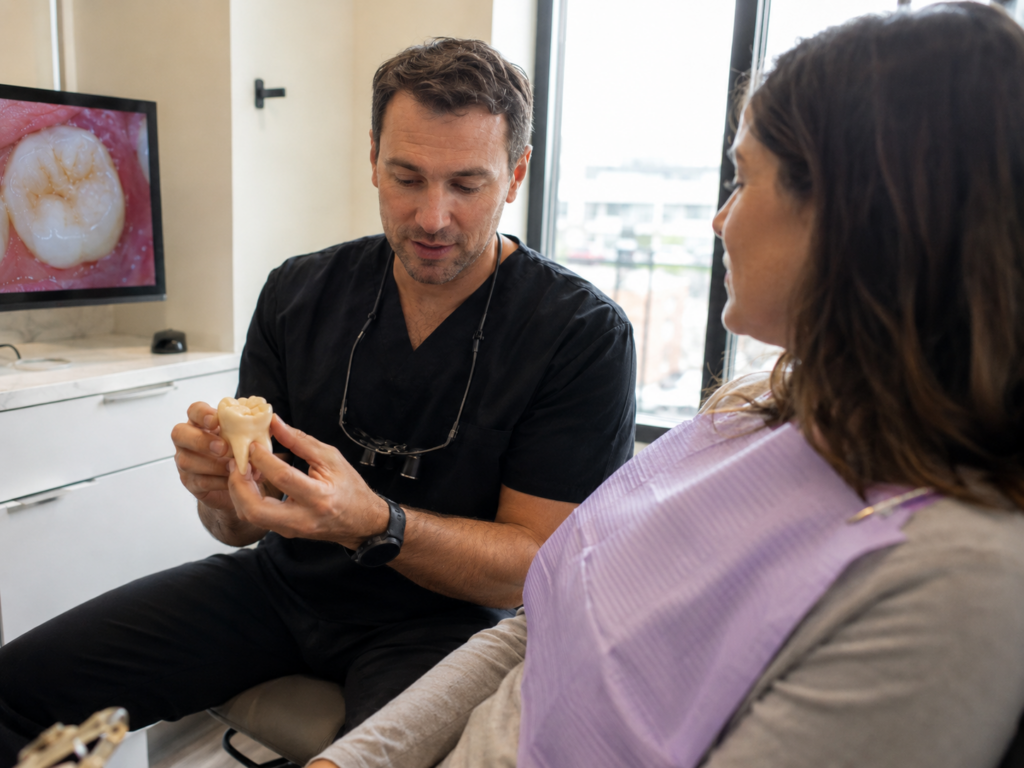
What Does Preserving Healthy Tooth Structure Mean?
A problem in one part of a tooth does not necessarily mean the entire tooth needs to be altered.
Preserving healthy structure means the dentist evaluates what is damaged, what remains sound, and what the tooth will need to function appropriately after treatment.
The goal is not simply to use the smallest restoration possible.
Instead, restorative planning balances several considerations:
- Treating decay or damage
- Preserving sound natural structure
- Protecting the remaining tooth
- Restoring appropriate function
- Giving the restoration adequate support
That balance can be different for every tooth.
A small area of damage may call for one approach, while a tooth that has already lost significant structure may need greater protection.
Why Is Healthy Natural Tooth Structure Valuable?
Natural tooth structure forms the foundation of a restored tooth.
When sound structure remains, preserving it allows the dentist to work with more of the patient’s natural tooth rather than removing healthy material unnecessarily.
This is one of the principles behind conservative dentistry.
Conservative treatment does not mean avoiding necessary dental work. It means making a thoughtful decision about what actually needs treatment and how much natural structure needs to be changed to provide that treatment.
The objective is to protect what remains healthy while appropriately addressing the problem.
How Does a Dentist Decide What Needs to Be Removed?
Before repairing a tooth, the dentist evaluates the location and extent of the concern.
Factors may include:
- How much decay or damage is present
- Where the affected area is located
- How much healthy tooth structure remains
- Whether an existing restoration is present
- How the tooth functions within the bite
- How much support the remaining tooth needs
- Which restoration is appropriate for the situation
These considerations help determine how much preparation is necessary.
That is why two teeth that appear to have similar problems may not require exactly the same restorative approach.
The Smallest Restoration Is Not Always the Best Restoration
Preserving natural structure should not be confused with automatically choosing the smallest possible treatment.
Suppose a tooth has only a limited area of damage and enough healthy structure remains to support a smaller restoration. In that situation, a conservative repair may be appropriate.
Another tooth may have lost substantially more structure. Trying to use an undersized restoration simply because it alters less of the tooth may not provide the support or protection that tooth needs.
True conservation means balancing preservation with appropriate treatment.
Sometimes preserving the tooth over the longer term requires a restoration that covers or supports more of it.
The question should not be, “What is the smallest thing we can do?”
A better question is, “What treatment appropriately addresses the problem while preserving healthy structure where possible?”
How Does the Type of Restoration Affect Tooth Preservation?
Different restorations are designed for different situations.
For a limited area of damage, dental fillings may be appropriate when enough sound tooth structure remains to support that type of repair.
Dental bonding may also be considered for selected cosmetic or structural concerns depending on their location, extent, and functional demands.
A dental crown may be recommended when a tooth has lost more structure and needs broader protection.
None of these options is automatically the most conservative choice in every situation.
A filling is not always better simply because it generally covers less of the tooth. Likewise, recommending a crown does not mean the dentist has abandoned conservative principles.
The appropriate restoration is the one that fits the actual condition of the tooth while balancing preservation, strength, and function.
Why Does Your Bite Matter?
A restored tooth does not function by itself.
Every time you chew, it interacts with neighboring and opposing teeth. The forces placed on that tooth can influence how much support it needs and how a restoration should be designed.
A dentist may therefore consider:
- The location of the tooth
- How much structure remains
- How the teeth come together
- The forces placed on the restored area
This is another reason treatment cannot be based only on how large a chip or cavity looks.
Preserving healthy structure remains important, but the restored tooth also needs to function appropriately within the patient’s bite.
How Can Modern Technology Support Conservative Care?
Modern dental technology can support restorative planning, but technology itself does not determine how much tooth structure should be removed.
Brentwood Family Dentistry uses CEREC Primescan technology for digital impressions and restorative workflows. Its role is to support the process of capturing information and planning restorations when appropriate.
The clinical decision still depends on the individual tooth.
Technology should support the dentist’s judgment rather than replace it.
This distinction is important because a digital workflow should not be interpreted as a promise that every tooth requires less preparation or that one restorative approach is automatically superior.
Why Patient Education Matters
When a dentist recommends repairing a tooth, it is reasonable to want to know why a particular restoration was chosen.
Useful questions include:
- What part of the tooth is damaged?
- How much healthy structure remains?
- Why is this restoration appropriate?
- How much preparation may be necessary?
- Are there other appropriate options?
- How does this treatment support the remaining tooth?
These conversations can make restorative recommendations easier to understand.
At Brentwood Family Dentistry, patient education is part of the practice’s personalized approach. Patients are encouraged to understand their options and participate in decisions about their oral health.
When Might a Tooth Need More Protection?
There are situations where a tooth has lost too much structure for a smaller repair to provide appropriate support.
That does not mean conservative care has failed.
It means the dentist needs to balance preservation with the tooth’s current condition.
A tooth with more extensive structural loss may require a restoration that provides broader protection. Trying to preserve every possible portion of the tooth at the expense of appropriate function or support may not be the most conservative decision.
The goal remains the same: avoid unnecessary alteration of sound structure while still treating the tooth adequately.
How Does Preventive Care Support Tooth Preservation?
Tooth preservation does not begin only when restorative treatment is needed.
Routine preventive care gives the dental team opportunities to identify developing concerns, monitor existing restorations, and evaluate changes over time.
Earlier identification does not guarantee that a smaller restoration will always be possible. It can, however, provide more information for treatment planning before a concern becomes more extensive.
Prevention also supports the broader goal of maintaining healthy natural teeth for as long as reasonably possible.
Questions to Ask Before a Tooth Is Repaired
If restorative treatment is recommended, consider asking:
- How much healthy tooth structure remains?
- What part of the tooth needs treatment?
- Why is this restoration appropriate?
- Is another conservative option also reasonable?
- How will the restoration support the remaining tooth?
- How do my bite and chewing forces affect the recommendation?
There may not always be several suitable treatment options, but understanding the reasoning behind the recommendation can make the decision clearer.
A Conservative Approach Looks at What Can Be Preserved
The purpose of restorative dentistry is not simply to make a damaged tooth look repaired.
The dentist also needs to consider what healthy structure can remain and what the tooth needs to continue functioning appropriately.
Sometimes a limited restoration may be enough. In other situations, greater protection may be needed.
Preserving healthy tooth structure means finding the right balance rather than following a predetermined rule.
At Brentwood Family Dentistry, the practice’s three-generation family approach combines modern care with personalized treatment planning and a commitment to helping patients understand their options.
If you have questions about why a particular repair has been recommended, contact us to discuss your treatment options with the Brentwood Family Dentistry team.